
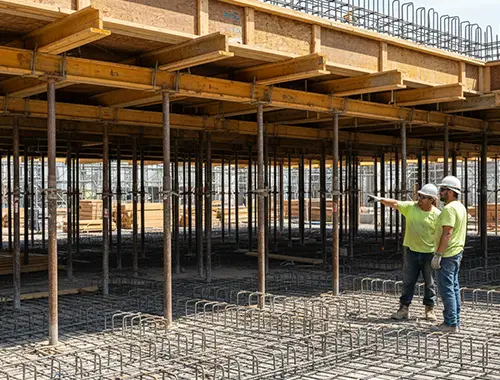
Reinforced Concrete Suspended Slab Forming
Reinforced Concrete Suspended Slab Forming
reinforced concrete suspended slab forming can make or break the rhythm of a low-rise or mid-rise project. When the formwork, shoring/reshoring, and rebar installation are planned as one system, you get predictable pours, cleaner tolerances, and fewer delays. When they’re treated as separate tasks, schedules slip—often at the worst time, when follow-on trades are waiting. If you’re building in Toronto or across Hamilton, the Niagara Region, Kingston, or Ottawa, here’s what matters most.
What “suspended slab” really means on site
A suspended slab is any structural slab supported by beams, walls, or columns rather than ground. That sounds straightforward—until you add:
- Tight cycle timelines
- Multiple trades needing access
- Dense reinforcement zones
- Penetrations for mechanical/electrical systems
- Shoring loads that must be respected at every stage
On low-rise and mid-rise builds, the slab cycle often sets the pace for the entire structure. That’s why selecting a mid-rise concrete forming contractor with specialized formwork expertise is a planning decision, not a last-minute purchase.
Formwork and shoring: the critical decisions
Suspended slabs are not just about getting the deck “up.” They’re about maintaining stability, alignment, and safe load paths until the concrete reaches required strength and the reshoring plan is complete.
Shoring and reshoring logic
Shoring supports the slab while it’s poured and curing; reshoring keeps the load paths safe as you advance to the next level. The reshoring sequence must align with the engineer’s requirements and your schedule reality. The fastest way to create downtime is to strip too early, re-shore poorly, or block access routes with a plan that wasn’t built for production.
This is also where strong safety practices matter—shoring is a structural system during construction, and it needs to be treated that way.
Consistent geometry improves cycle time
Low-rise structural concrete forming often benefits from repetition: consistent bay sizing, standardized edge conditions, and clear pour breaks. Even small changes—drop panels, step-downs, or complex perimeter geometry—should be isolated and detailed so crews can execute without improvising in the field.
Rebar: where the schedule pressure shows up
Rebar is frequently the hidden bottleneck on suspended slabs. Congestion builds around:
- Column heads and beam intersections
- Shear wall boundaries and core areas
- Openings and sleeves
- Transfer zones and thickened areas
When reinforcement is dense, access for tying, spacing, and vibration becomes limited. The best results come when your forming scope includes clear rebar reinforcing coordination—sequencing what gets installed first, what must be left open for embeds, and how bar placement will be verified before concrete placement.
If you’re scoping a slab package, this is the time to align the slab plan with formwork and rebar coordination so you’re not solving conflicts during a pour window.
Pour sequencing: control the risk points
Every suspended slab pour has moments where risk increases—around edges, openings, congested reinforcement, and transitions. A good forming plan addresses those risk points directly:
- Pour breaks that follow structural logic
- Clear placing routes and pump positions
- Consolidation access in tight rebar zones
- Straightforward inspection points before each pour
The goal isn’t “just get it poured.” The goal is consistent production without rework. That’s how you keep a mid-rise forming cycle stable and avoid cascading schedule issues.
Quality checks that prevent rework
Suspended slab issues are expensive because they affect everything above and below. A disciplined approach focuses on a few repeatable checks:
- Line, level, and deck stability before placement
- Edge form alignment and consistent slab thickness
- Reinforcement placement and cover verification
- Clean, safe working areas so inspections don’t get delayed
High-quality structural execution is not a slogan—it’s the difference between a slab that supports smooth framing and layout, and one that triggers corrective work and trade conflicts.
Selecting the right forming partner
When you compare forming contractors for suspended slabs, look beyond price. Ask how they plan to execute the cycle, how they manage reshoring, and how they coordinate reinforcement and pours. The right partner will talk through production realities and safety controls—not just quantities.
If you want to learn more about how GBC Concrete Forming Inc approaches structural slab work, visit our About page to understand our specialized formwork expertise and our focus on high-quality structural execution. We also list our industry associations and platforms on our Associations page.
Next step: align scope before tender pressure hits
If you’re planning a low-rise or mid-rise project with suspended slabs in Toronto, Hamilton, the Niagara Region, Kingston, or Ottawa, the best time to reduce risk is before the schedule tightens. Use our FAQs to clarify common forming questions, then talk to our estimating team through our Contact page. If you’re ready to price the work, you can also request a quote for your project and we’ll review your slab scope, formwork approach, and production requirements.